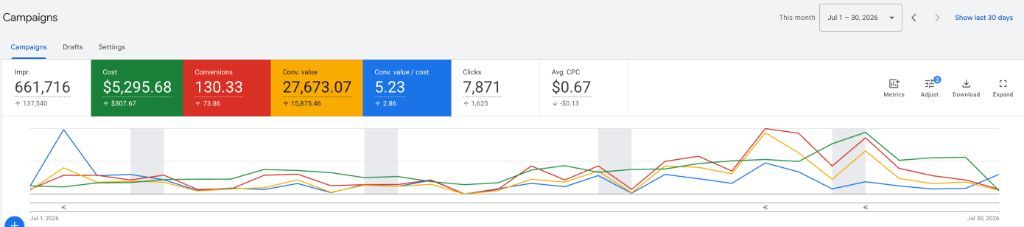
A luxury fashion brand's Google Ads account in the US ran for seven years at an average 298% ROAS: workable, but well short of what a 9,000+ product catalog could deliver. Rebuilding the account around its real hero products produced the best month in its entire history: 523% ROAS and $27,673 in revenue on $5,295 spend.
The Challenge
The client is ventutto.com, a luxury fashion brand with a catalog of more than 9,000 SKUs and seven years of advertising history on Google Ads. Average ROAS across that whole period sat at 298%. That's workable, but for a catalog and account history of this size, clearly below what the account could actually do.
A detailed audit turned up four structural problems at once. More than 9,000 products sat in one catch-all campaign, so hero products got the same budget as items that barely sold. Performance Max was bidding on searches for the brand's own name, artificially inflating reported ROAS and hiding the true cost of acquiring a new customer. Conversion data didn't match up across GA4, Shopify, and Google Ads. And sunglasses, apparel, footwear, and accessories were all competing for the same budget despite having completely different sales economics.
What We Did
We rebuilt the account around the catalog's real hits in five steps.
Hero product analysis
We mined more than 9,000 SKUs to find the true top performers: products with ROAS ranging from 400% to over 6,000%, buried inside the broader catalog.
PMax segmentation
Using Custom Labels, we isolated hero products into dedicated campaigns instead of letting them blend in with the rest of the catalog.
Dual asset groups
We split campaigns into two groups: one built around full creative, one running Feed-Only Shopping, each suited to a different placement scenario.
Brand protection
We moved branded searches into their own campaign and added exclusions, so reported ROAS reflected real performance instead of traffic from people already searching for the brand directly.
Tracking fix and phased bidding
We fixed UTM tagging to reconcile data across systems and started with a conservative 350-400% target ROAS, letting the algorithm build signal before we raised the bar.
The Result
July 2026 became the best month in the account's seven-year history. ROAS climbed from an average of 298% to 523%, an account record. In a single month, the account delivered more than 130 conversions and $27,673 in revenue on $5,295 in spend.
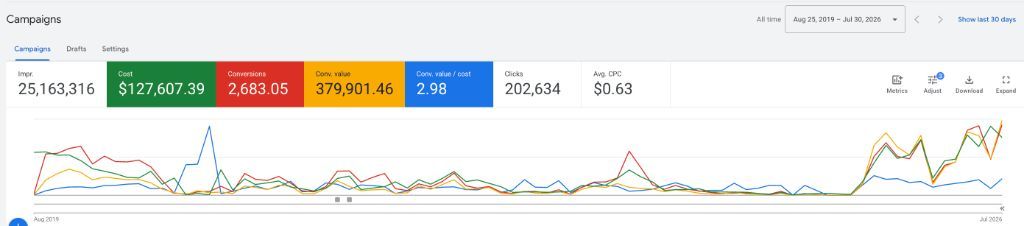
For comparison, the previous seven years combined produced 2,683 conversions and $379,901 in revenue on $127,607 in spend. One month after the rebuild generated nearly 5% of the account's entire seven-year revenue, at roughly twice the historical average efficiency.
The result didn't come from a bigger budget. It came from better data: the right catalog segmentation, clear boundaries between campaigns, and signals that let Google's algorithm do its job at full capacity.